
Polished vs Beveled Mirrors for Bathroom Vanities
The edge of a bathroom mirror changes more than its outline. When comparing polished vs beveled mirrors , you're choosing between a clean, minimal finish and a decorative glass detail that catches the light.
A polished edge keeps attention on the mirror's shape and reflection. A beveled edge adds a narrow angled border around the glass, which can make a simple vanity feel more finished. The right choice depends on your bathroom style, wall space, lighting, and installation plan.
What Polished vs Beveled Mirrors Really Means
The difference comes from how the glass edge is finished after the mirror is cut.
A polished edge , often called a flat-polished edge, has a smooth surface that stays nearly perpendicular to the mirror face. The glass fabricator grinds the raw edge, removes sharp points, and buffs it to a clean finish. The result is a simple perimeter with no angled reflective band.
A beveled edge has an angled strip cut around the outer perimeter. That strip is polished as well, but it slopes away from the main face of the mirror. As light reaches the angle, the edge can create a subtle highlight or prism-like effect.
Neither finish means the same thing as tempered glass. Edge polishing and beveling describe the shape and finish of the perimeter. Tempering describes a heat-treatment process that changes the glass's safety characteristics. If you need safety glass for a particular application, ask your glass professional about the correct specification separately.
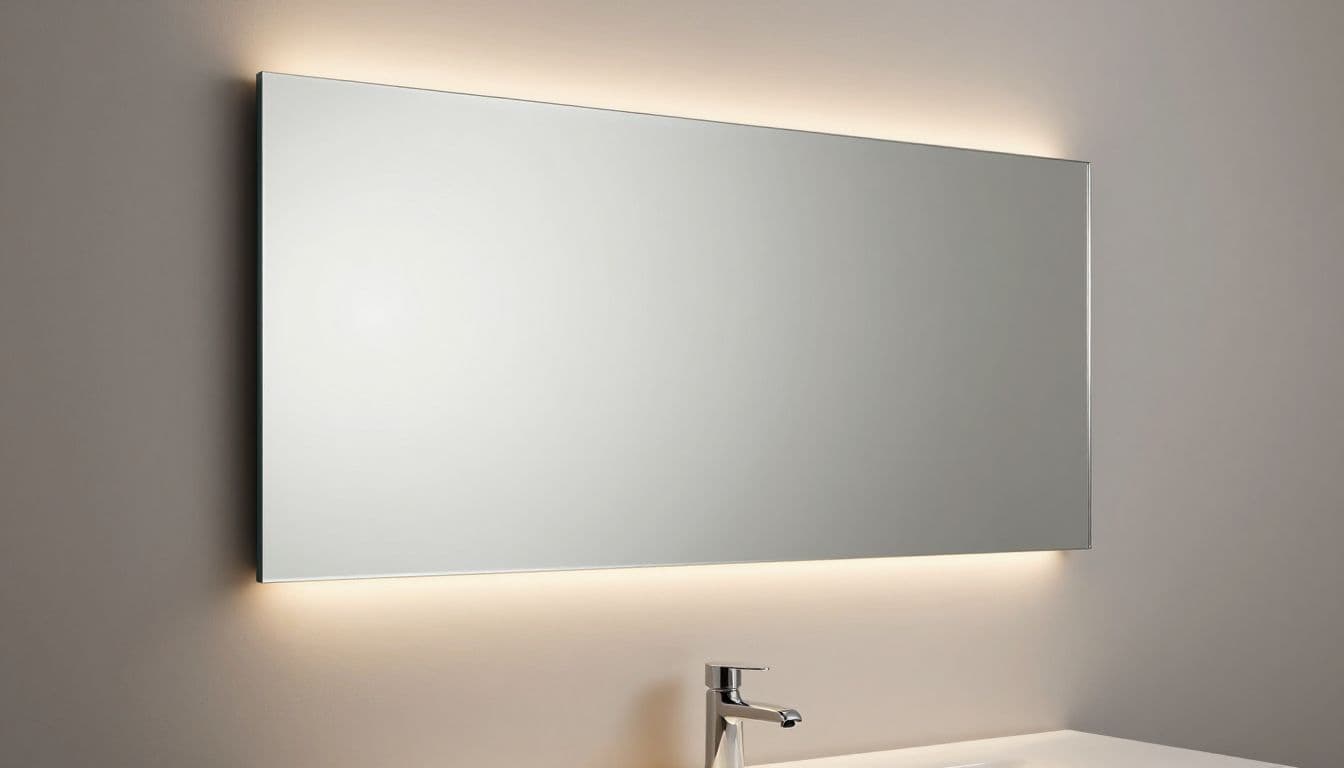
How a polished edge looks
A polished edge is a strong fit for frameless mirrors, especially when you want straight lines and an uncluttered wall. Because the perimeter doesn't angle inward, the mirror keeps a crisp, uninterrupted shape.
This finish works well with contemporary vanities, floating cabinets, large-format wall mirrors, and simple rectangular designs. It also pairs easily with metal frames or wood frames because the edge doesn't compete with the frame profile.
The smooth edge is safer to handle than a raw cut edge, but it still needs careful installation. A polished edge isn't a rounded corner. If you want softer corners, ask for radius corners, eased corners, or another shape during the design stage.
How a beveled edge looks
A beveled edge adds a visible border without requiring a separate frame. Many residential bathroom mirrors use a narrow 1/2-inch or 1-inch bevel, although custom fabricators can quote different widths and profiles.
The angled strip reflects light differently than the flat center. Under vanity sconces or overhead lighting, that border can add depth around the mirror. In a traditional, transitional, or upscale bathroom, the detail may provide the finished look that a plain frameless mirror lacks.
A bevel also reduces the straight-on reflective area slightly because part of the perimeter angles away from the wall. On a large mirror, that difference is usually minor. On a narrow mirror above a small sink, the usable face area matters more.
Polished and Beveled Edges Compared
Both finishes can be custom-cut to fit your vanity, but they create different results. This comparison makes the main differences easier to scan.
| Feature | Polished edge | Beveled edge |
|---|---|---|
| Edge profile | Smooth, flat-finished perimeter | Angled strip around the perimeter |
| Overall style | Minimal, modern, clean | Decorative, dimensional, more traditional |
| Light effect | Little edge reflection | Creates highlights along the bevel |
| Reflective area | Maximizes the flat mirror face | Slightly reduces the flat face at the border |
| Frame compatibility | Works with nearly any frame | May be partly hidden by a deep frame |
| Cleaning | Simple perimeter to wipe | Extra angled surface to clean |
| Typical price | Often the more economical option | Often costs more because of added finishing |
| Best use | Frameless or simple framed mirrors | Accent mirrors and detailed bathroom designs |
The table shows a general pattern, not a fixed price rule. Size, thickness, shape, corner work, cutouts, and installation can affect the final quote more than the edge style alone.
Which Edge Fits Your Bathroom Design?
Your vanity and wall layout should guide the decision. A mirror edge looks different in a compact powder room than it does across a double-sink cabinet.
A polished edge usually suits a bathroom with flat-panel cabinetry, a thin countertop profile, matte black or brushed metal fixtures, and limited wall decoration. It keeps the composition calm. If the room already has a patterned backsplash or bold tile, the simple edge can prevent the wall from feeling busy.
Beveled edges work well when the bathroom needs a finishing detail. They pair naturally with framed cabinetry, decorative sconces, marble-look surfaces, traditional plumbing fixtures, and warm metallic finishes. The bevel can also echo angled details in the room, such as a faceted light fixture or a cabinet with raised-panel doors.
Match the edge to the mirror shape
A rectangular polished-edge mirror has a sharp architectural quality. It can run nearly wall to wall above a vanity and create a broad, uninterrupted reflection. Rounded corners soften that look without adding a decorative border.
A beveled rectangle feels more formal, while a beveled oval or arch can look ornamental. However, the bevel must have enough room to remain visible. A very narrow mirror, a tight wall opening, or a thick frame may hide much of the angled edge.
For a double vanity, compare one wide mirror with two individual mirrors before ordering. Two beveled mirrors can add symmetry and detail, while one polished mirror can make the wall appear wider. Check the locations of faucets, sconces, outlets, and cabinet divisions before choosing.
Consider the lighting
Lighting affects how much value you get from a bevel. Wall sconces beside the mirror can highlight the angled perimeter from both sides. Overhead lighting may create a smaller highlight, depending on the fixture's height and beam direction.
A polished edge stays visually quiet under changing light. That makes it a practical choice when the bathroom receives strong daylight, has multiple light sources, or uses a backlit mirror. A beveled edge has more visual activity, which may be welcome in a simple room but distracting beside busy tile.
A bevel is a design detail, not a substitute for good mirror proportions. A beautifully finished edge can't correct a mirror that is too narrow, too low, or poorly centered.
Installation Details That Matter in Southwest Florida
A custom mirror needs accurate measurements before glass fabrication begins. Measure the finished wall opening, vanity width, backsplash, sconces, outlets, and nearby cabinets. Account for the mirror's overall outside dimensions, not only the flat reflective area.
Before drilling, confirm the correct bathroom mirror height. A common starting point is 4 to 6 inches between the top of the backsplash and the bottom of the mirror, but lighting, household height, wall space, and mirror size can change that placement.
Installation hardware also depends on the mirror's size and weight. Small mirrors may use clips or a rated mirror adhesive. Larger wall mirrors may need a combination of adhesive and mechanical support, based on the wall surface and installation method. A professional installer can identify studs, masonry, tile, or drywall conditions before the mirror arrives.
If the design includes outlet holes, notches, or openings for light fixtures, approve those details before fabrication. Tempered glass cannot be cut after tempering, and any custom cutout needs precise measurements.
Humidity and coastal air
Bathrooms in Cape Coral and other Southwest Florida communities face frequent humidity, strong air conditioning, and, in some areas, salt-laden air. Those conditions make edge care and installation quality especially important.
Mirror backing can deteriorate when moisture reaches an unprotected edge repeatedly. That damage may appear as dark spots or cloudy areas near the perimeter. The edge finish itself doesn't make a mirror waterproof, so ventilation and proper placement still matter.
Use an adhesive rated for mirror installation rather than a general construction adhesive. Some products contain solvents that can damage the mirror backing. Leave the recommended clearance around the mirror, keep water from pooling against the bottom edge, and follow the product directions for any sealant.
A bathroom fan helps remove moisture after showers, but it doesn't replace sound installation. The mirror should sit securely, stay aligned, and avoid direct contact with wet surfaces that can hold water against the glass.
Cost, Care, and Ordering Decisions
For the same size and shape, a polished edge often costs less than a beveled edge. Beveling requires an angled profile and additional finishing work. Still, the total price may change with mirror thickness, corner radius, custom shapes, light cutouts, mounting hardware, delivery, and labor.
A standard 1/4-inch mirror is common for many residential vanity installations, but the right thickness depends on the size and support method. Ask for the complete specification rather than comparing edge prices alone. The quote should identify the glass type, thickness, outside dimensions, edge finish, corner style, cutouts, and installation scope.
Care is simple for both options. Spray glass cleaner onto a soft, lint-free cloth instead of flooding the perimeter. Wipe the mirror face first, then dry the edge. For a beveled mirror, clean the angled strip with a separate pass so residue doesn't collect where the bevel meets the flat face.
Avoid abrasive pads, razor blades, and harsh chemicals near the edge. Also, don't let hairspray, toothpaste, or standing water remain on the perimeter. Regular drying matters more in a humid bathroom than occasional aggressive cleaning.
When requesting a custom quote, bring photos of the vanity wall and note whether the mirror will sit over tile, a backsplash, or bare drywall. A glass company can then review access, mounting conditions, and the edge detail together.
Choosing Between Polished vs Beveled Mirrors
Choose a polished edge when you want the largest uninterrupted reflection, a clean frameless appearance, or a restrained modern design. It is also a practical choice for a wide mirror that needs to blend into the wall.
Choose a beveled edge when you want a decorative border, added light reflection, or a more traditional and finished appearance. It works best when the mirror has enough width for the bevel to remain visible and the room has lighting that can reach the angled surface.
The best polished vs beveled mirrors decision comes down to the room's proportions and the look you want at the vanity. Neither edge is universally better. A precise measurement, suitable mirror backing, and proper installation will have a greater effect on long-term satisfaction than choosing a trend.
Conclusion
Polished and beveled mirrors can both work beautifully above a bathroom vanity. A polished edge gives you a clean, broad reflection with minimal visual detail. A beveled edge adds dimension and catches light around the perimeter.
For a modern bathroom with strong lines, polished glass is often the natural fit. For a more decorative room, a beveled border may provide the right finishing touch. Measure the space first , then choose the edge that supports the vanity, lighting, and style already in your home.